


Australia’s migration story has flipped. Not long ago, headlines shouted about “record arrivals” and “runaway migration.” Now the latest data shows a very different picture: net overseas migration is falling fast, even though the politics around it are louder than ever.
In this article, we will walk through what the new numbers really say, why migration is dropping, who is still coming here, and what it all means for housing, jobs, and Australia’s future.
What Net Overseas Migration (NOM) really means?
Net overseas migration, often called NOM, is a simple idea: it is the number of people who come to live in Australia long term, minus the number who leave, over a set period.
If 600,000 long term arrivals come in a year and 300,000 long term residents move out, the net overseas migration for that year is 300,000.
NOM is not the same as visas granted or airport arrivals.
Many people fly in for short holidays or business trips and then fly out again. They do not all count toward NOM. The Australian Bureau of Statistics (ABS) focuses on people who stay in Australia for 12 months or more over a 16 month period, because these are the people who change the size of the population, the demand for housing, and the pressure on services.
The big shift: migration is falling from record highs
From pandemic rebound to easing flow
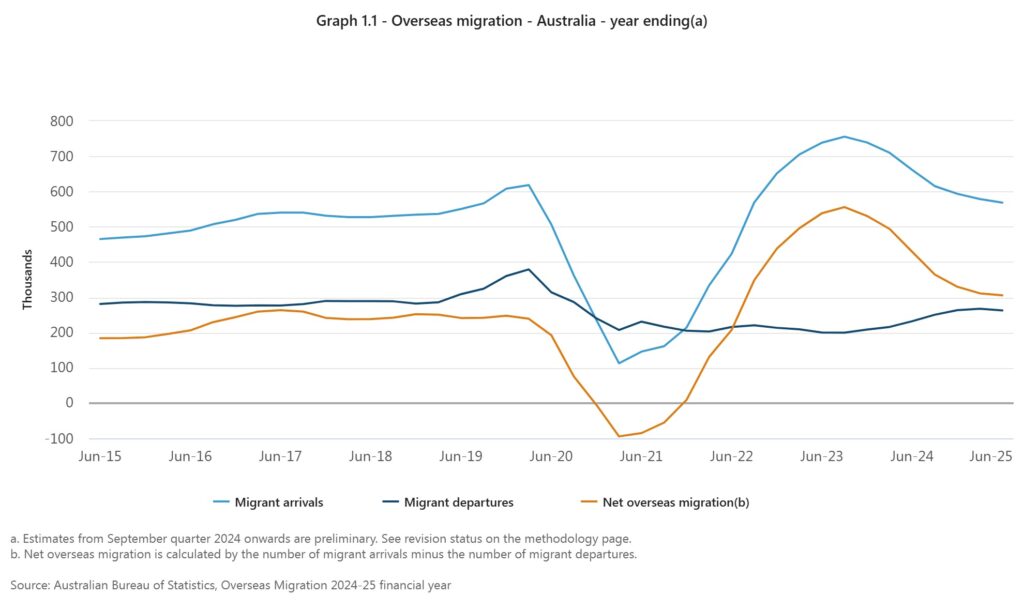
After Australia reopened its borders following Covid 19, migration surged. In 2022–23, net overseas migration jumped to a record high of more than 550,000 people as students, workers and families rushed back.
That wave is now clearly easing. ABS figures for the 2024–25 financial year show net overseas migration of about 306,000, a drop of roughly 45 percent from the peak. The federal government’s latest update goes further.
Home Affairs Minister Tony Burke has stated that annual NOM to December 2025 is around 301,000, and that it has been falling for several quarters in a row.
This is not just a one off dip. It looks like the start of a new phase, where migration is still strong by historic standards, but not at the extreme levels seen just after the border reopened.
Still high compared with pre Covid
Even with this big fall, today’s migration intake is not “low.”
Many pre pandemic years saw lower levels of NOM than the current 300,000 plus figure. Australia’s net migration is now below the recent record, but still above the long run average that shaped earlier debates on population and planning
.
This gap between “falling” and “still high” explains a lot of the political noise.
Supporters of the government say the numbers prove that migration is being brought back under control in a careful way. Critics argue that even at 300,000, migration is too high for a housing market under stress and infrastructure that is already stretched.
Arrivals vs Departures: what is actually changing?
Fewer people coming, more people going

The shift in NOM is driven by two big moves at the same time.
First, the number of people arriving to live in Australia is falling. Second, the number of people leaving is rising.
According to the ABS, total migrant arrivals fell about 14 percent in 2024–25 to around 568,000 people. Departures rose about 13 percent to about 263,000 over the same period.
When you combine those two changes, the net figure of NOM has drops sharply. Fewer people are joining the population, and more are exiting at the same time.
In simple terms, the “tap” has been turned down and the “drain” has been opened a little wider.
The role of temporary migrants and students
Temporary visa holders remain the biggest part of the migration story.
The ABS data shows temporary migrants drove most of the record NOM in 2022–23, and they still make up the largest share of arrivals now, but at lower levels.
Total arrivals on temporary visas fell from about 458,000 to around 363,000 in one year.
That is a very large drop. The fall is most obvious in international student numbers, which have been hit by new rules and by a natural post Covid slowdown.
Student arrivals were about 204,000 at their recent peak and have now dropped to roughly 157,000 in the 2024–25 year.
At the same time, more former students are leaving Australia as they finish their courses and their visas expire. This rise in student departures plays a big part in pushing NOM down.
Who is coming to Australia now?
Australia’s migration program draws people from all over the world, but the mix is changing.
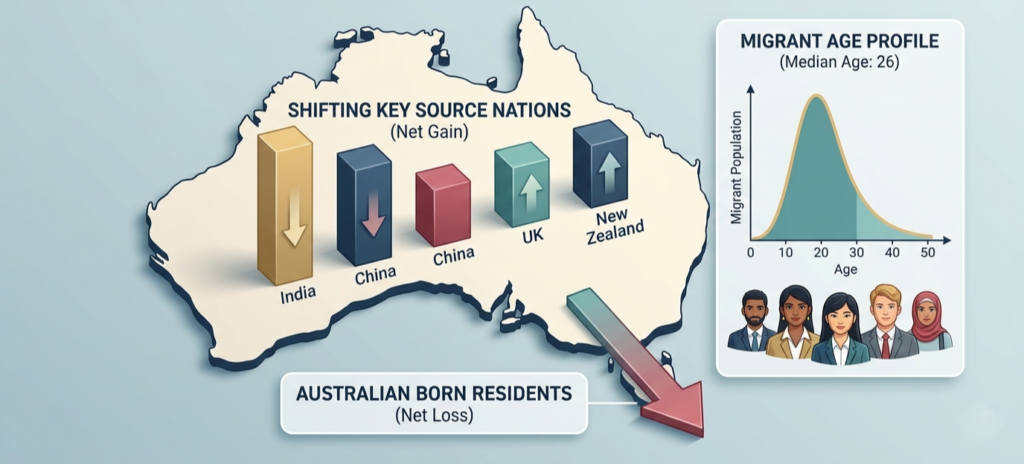
The latest ABS data shows that India and China remain key source countries, along with the United Kingdom and New Zealand.
However, net gains from India and China have fallen from recent highs, while net gains from the UK and New Zealand have grown compared with earlier years.
This means a larger share of new long term arrivals now hold passports from other English speaking countries, and a slightly smaller share come from the two big Asian source nations that dominated earlier in the decade.
Another detail often missed is that Australia consistently records a net loss of Australian born residents, as more Australians move overseas than return.
So overall population growth from migration now depends heavily on people born overseas, particularly younger adults who come to study or work.
Young, working age migrants
The ABS reports that the median age of migrant arrivals is around 26, meaning half are younger than that and half are older.
Most arrivals are in their early twenties and early thirties, with a slight majority being women.
This matters for the labour market.
Young migrants are more likely to be in education or work, and less likely to draw on age related health and pension benefits soon. They add to rental demand, public transport use and local spending, but they also help fill jobs in key sectors like hospitality, care and construction.
Policy and politics: why migration is falling?
The Albanese government argues that the fall in net overseas migration is the result of deliberate, targeted policy changes.
According to the Home Affairs Minister, the aim is to move away from what he calls “a Big Australia by stealth” and towards a more managed, sustainable intake focused on skills and integrity.
Key moves include tightening rules around international education, cracking down on visa “hopping,” and closing loopholes that allowed some people to stay long term without a clear pathway or genuine study and work plans.
The government says these changes are already showing up in the numbers, with student driven migration back to levels seen before the pandemic.
Critics say it is still too high
The opposition and some think tanks do not agree that the problem is solved.
They point to the fact that NOM remains above 300,000 which still higher than many pre Covid years and argue that this is “the new normal” under Labor.
These critics link high migration to rental stress, congestion, school crowding and long hospital wait times. Some reports also warn that large intakes with weak planning place “immense pressure” on Australia’s economic and social infrastructure.
The same ABS tables that the government uses to argue migration is “coming down” are used by opponents to argue it is “still too high.”
This split will likely remain a central political fight, especially as new parties on the right seek to win votes by calling for deeper cuts to migration.
Clamping down on visa hopping
The government has also tightened the rules that allowed people to enter on one visa type and then switch to another from inside Australia.
This is sometimes called “visa hopping,” where a person might arrive on a visitor visa, switch to a student visa, then later to another temporary visa without leaving.
By reducing these pathways and lifting scrutiny, the government expects fewer long term stays that were never part of the original migration plan.
This helps explain why visitor related NOM is now falling, even if short term tourism is strong again.
Housing: will lower migration ease the crunch?
One of the hottest questions in the migration debate is housing.
Many renters and first home buyers want to know: if net overseas migration is falling, will that finally bring some relief?
Lower NOM does reduce the speed of population growth.
Fewer new residents means fewer households to house, all else equal. Over time, this can take some pressure off rents, especially in high demand inner city areas that attract many migrants and students.
However, the effect is not instant.
Leases, construction pipelines and planning rules all work with long delays. At the same time, Australia has faced low building completion rates and rising construction costs, which limit new supply regardless of migration.
The honest answer is that lower migration helps, but it is only one part of the housing puzzle. Without more homes being built and better planning, the relief from lower NOM alone will likely be modest.
Local impacts: big cities and student hubs
The impact of changing migration is not uniform across the country.
Cities like Sydney and Melbourne, which host large numbers of international students and new migrants, feel the housing pressure most intensely.
When student numbers fall, demand for inner city share houses and small units can soften.
This may bring small rent relief in certain suburbs around big campuses. But other areas, especially outer suburban growth corridors with tight supply, may not see much change at all.
Regional towns that rely on specific visa programs or on local universities may also feel changes. If fewer students or workers arrive, some local rental markets could loosen, while some small businesses that serve these groups might struggle.
Jobs and skills: help or harm from lower migration?
Even with the fall in NOM, Australia still brings in many young, working age migrants.
They are central to sectors such as health care, aged care, hospitality, agriculture, construction and technology.
Employers in these areas often say they cannot find enough local staff, especially in regional areas and in highly skilled roles.
Migrants, including international graduates, are a key part of the solution, helping to keep hospitals staffed, aged care homes running and building projects moving.
Risk of cutting too far
This raises a risk. If migration is cut too sharply or too quickly, some sectors could face more serious labour shortages just when Australia needs to build more homes and care for an ageing population.
The government argues that its current changes are targeted at low quality or exploitative pathways, not at genuine skilled workers and high value students.
Its stated goal is to bring NOM down to what it calls “a more sustainable level” while still attracting the talent Australia needs. Whether it can hold this balance will become clearer as more data is released over the next few years.
Universities and regional economies
International students are not just numbers in migration tables.
They are a key source of income for universities and a lifeline for many small businesses near campuses: cafes, share houses, transport, and retail.
With student arrivals down by tens of thousands compared with the peak, many universities face financial pressure.
Some may respond by cutting courses, lifting fees for domestic students, or chasing new markets overseas. Others are working harder to attract students to regional campuses under schemes that encourage study and settlement outside major capitals.
Regional communities and population balance
In regional towns, even a few hundred extra international students or skilled workers can make a real difference to the local economy and to population balance.
Visa programs that encourage people to live and work outside major cities are one way governments try to spread the benefits of migration more evenly.
If overall NOM continues to fall, making sure regional areas still get the skills they need – in health, teaching, engineering and trades – will be a major policy challenge.
What might happen next?
The government has signalled it wants to bring net overseas migration down closer to long term averages over the next few years, rather than keeping it near recent record levels.
Future numbers will depend on global demand for study and work in Australia, on economic conditions, and on how strictly new integrity rules are enforced.
Whatever happens, the politics of migration will remain intense, especially as new parties on the right try to link high migration to broader concerns about housing and living costs.
Is migration to Australia still at record highs?
No. Net overseas migration has fallen from a record above 550,000 in 2022–23 to around 300,000 in the latest year, a drop of more than 45 percent.
However, it is still higher than in many pre Covid years, which is why some people say it is “still too high.”
Why are fewer international students coming now?
Student numbers are down because the post Covid catch up wave has passed and new integrity rules have made it harder to use student visas mainly as a path to work.
Some students are also choosing other countries, and more former students are leaving as they finish their courses.
How does lower migration affect rent prices?
Lower migration slows population growth, which can ease some pressure on rentals over time, especially in areas with many new arrivals.
But rent levels also depend on how many homes are actually built, and on interest rates and investor decisions, so the impact is not instant or simple.
What is the difference between net overseas migration and permanent migration?
Net overseas migration counts how many people join or leave the population by staying long term, regardless of whether they are on temporary or permanent visas.
Permanent migration refers only to people granted permanent visas. Many people who shape NOM arrive and live here first on temporary visas.
Will Australia keep cutting migration numbers?
The government says it plans to reduce net overseas migration to a more sustainable level, closer to long term trends, while still bringing in needed skills.
How far and how fast it goes will depend on politics, the economy, and how the new rules for students and other visa holders play out.
Australia’s migration story is no longer one of endless growth.
Net overseas migration is clearly falling from its post pandemic peak, as temporary arrivals slow, more people leave, and new integrity rules reshape the student and visa system.
The challenge now is to find the right balance: easing pressure on housing and services, while still welcoming the people, skills and energy that have helped build modern Australia.