

Your petrol is cheaper. Your tax bill is going down. And the government just committed billions to keep the lights on and the shelves stocked.
But before you breathe a sigh of relief, here’s the thing: Australia is in the middle of one of the most serious economic shocks in recent memory. So what exactly is in this budget, and why should everyday Australians care?
Let’s break it all down in plain language.
The Big Picture: Why This Budget Matters Right Now
The 2026–27 Australian Federal Budget, titled Resilience and Reform, lands at a critical time. Conflict in the Middle East has choked global oil supplies, sent fuel prices soaring, and pushed inflation back up just when it seemed like things were settling down. The government says inflation is forecast to hit 5 per cent through the year to June 2026, mostly because of the oil price spike.
Economic growth is expected to slow to 1¾ per cent in 2026–27, down from 2¼ per cent the year before. That sounds bad, but here’s the silver lining: Australia is still growing faster than every major advanced economy, unemployment remains low, and public debt is lower than almost every comparable country in the world.
The government has found $63.8 billion in savings and reprioritisations to keep the budget on track and claims the budget is a combined $44.9 billion stronger over the forward estimates than the mid-year update.
Fuel Crisis: What the Government Is Doing About Petrol Prices
This is the issue that hit Australians hardest, and it’s where the government moved fastest.
The centrepiece is a $2.9 billion package that more than halved the fuel excise, dropping it from 52.6 cents per litre to just 20.6 cents per litre, for three months from 1 April 2026. For a teacher like Anjali who fills a 40-litre tank once a week, that’s roughly $170 saved over the three-month period.
But it goes much deeper than a temporary price cut:
- A $7.5 billion Fuel and Fertiliser Security Facility to lock in more international fuel supply
- A $3.2 billion Australian Fuel Security Reserve to hold around 1 billion litres of diesel and jet fuel, pushing Australia’s reserves to 50 days of supply
- Over 1 billion extra litres of petrol and diesel already secured for March to June
- A new 20 per cent domestic gas reservation, requiring LNG exporters to keep a share of production for Australian users from 1 July 2027
The government also launched a National Fuel Security Campaign to encourage Australians to reduce fuel use and ease pressure on national supplies.
Tax Cuts: Money Back in Your Pocket
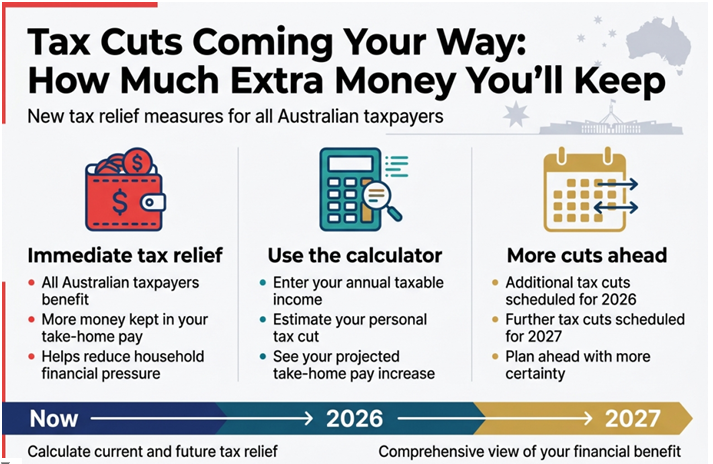
Here’s where most Australians will feel the biggest difference. The government is delivering five rounds of tax cuts in total, stacking them on top of each other.
Starting 1 July 2026, the 16 per cent tax rate on income between $18,201 and $45,000 drops to 15 per cent. Then from 1 July 2027, it drops again to 14 per cent. On top of that:
- A new $250 Working Australians Tax Offset (WATO) kicks in from 2027–28, benefiting over 13 million workers, and 97 per cent will get the full amount
- A $1,000 instant tax deduction from 2026–27 lets workers claim $1,000 off their taxable income without keeping receipts, benefiting 6.2 million workers with an average saving of $205
Put it all together, and a worker on average earnings of $81,245 per year could be up to $2,816 better off from 2027–28 compared to 2023–24 settings. That’s not a one-off payment. It’s a permanent annual benefit.
Housing: Help for First Home Buyers and Renters
Owning a home in Australia has felt like a dream slipping further away for millions of people. This budget takes direct aim at that problem.
The government is putting $2 billion into a new Local Infrastructure Fund to build the roads, water, power and sewerage connections needed to unlock up to 65,000 new homes over the decade. This brings total housing infrastructure investment to $6.3 billion.
On the tax side, two big structural reforms kick in from 1 July 2027:
- Negative gearing will be limited to new builds only. Investors who buy existing homes after Budget night won’t be able to deduct losses against other income like wages
- The Capital Gains Tax (CGT) discount shifts from a flat 50 per cent to an inflation-based model, with a minimum 30 per cent tax on gains
Together, these reforms are expected to help around 75,000 additional Australians become homeowners over the next decade, roughly reversing ten years of declining home ownership. The ban on foreign buyers purchasing established homes has also been extended to mid-2029.
For renters, most states have now banned no-grounds evictions, capped rent increases to once a year, and set minimum rental standards with federal government support. Commonwealth Rent Assistance rates have risen by over 50 per cent since March 2022.
Healthcare: Cheaper Medicine and More Free Clinics
The government is putting serious money into keeping Australians healthy and making it much more affordable.
The headline number is a landmark $25 billion in additional public hospital funding, bringing the total to a record $220.3 billion over five years. That’s the biggest hospital funding boost in Australia’s history.
On medicines, the government has already cut the general PBS co-payment to $25, the lowest in over 20 years, and frozen the concessional rate at $7.70 until 2030. This budget adds $5.9 billion in new PBS listings, covering treatments for cystic fibrosis, various cancers, chronic kidney disease, and more.
The 137 Medicare Urgent Care Clinics are being made permanent with a $1.8 billion investment, and by July 2026, four in five Australians will live within a 20-minute drive of one. These clinics have already delivered almost three million free visits.
Business and the Economy: Cutting Red Tape, Backing Investment
The government isn’t just focused on household relief. It’s trying to make Australia’s whole economy sharper and more competitive.
Regulatory burden will be cut by a whopping $10.2 billion per year, and building a Single National Market is expected to add around $13 billion to long-run annual GDP. Key moves include:
- Abolishing another 497 nuisance tariffs, saving businesses over $157 million per year
- A permanent $20,000 instant asset write-off for small businesses with turnover up to $10 million
- Loss carry back reintroduced for up to 85,000 companies, letting businesses get refunds on past tax when they make a loss
- $1.5 billion invested in research institutions including CSIRO and the Square Kilometre Array
- Up to $70 million in AI Accelerator grants to boost domestic AI development
- For tradies and small business owners, access to building standards referenced in Australian legislation will be made free, saving up to $1,600 per year
Defence and National Security: A Historic Investment
Australia is also spending big on keeping the country safe in an increasingly unstable world.
The 2026 National Defence Strategy commits an additional $53 billion over the next decade, making it the biggest defence investment in Australian history. This includes:
- Up to $130 billion for nuclear-powered submarines
- Up to $15 billion for autonomous and uncrewed systems like the Ghost Bat drone
- An initial $12 billion to build the Henderson Defence Precinct in Western Australia as a world-class naval shipbuilding hub
In the wake of the Bondi antisemitic terrorist attack, $604.2 million has been committed to counter hate speech, violent extremism and terrorism, including $42.9 million in mental health support for the affected communities.
This budget is being shaped by a global crisis, but it’s also trying to fix problems Australians have lived with for years: unaffordable housing, high out-of-pocket medical costs, and a tax system that many felt wasn’t working in their favour.
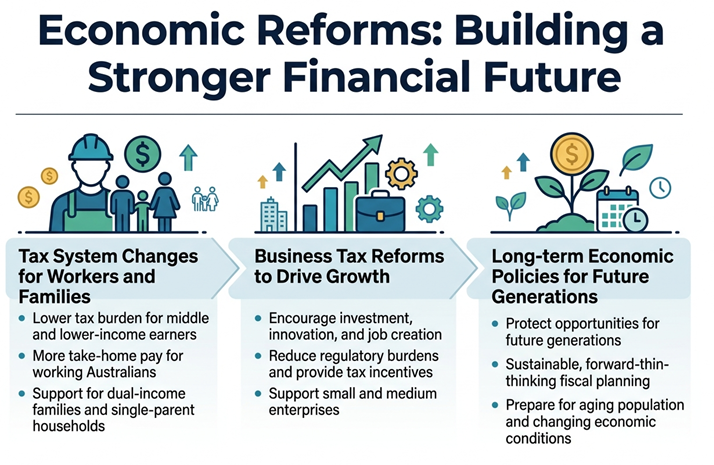
The government says the underlying cash deficit will be $31.5 billion in 2026–27, with the budget projected to return to balance by 2034–35. Whether that happens depends heavily on how long the Middle East conflict disrupts global oil markets and how effectively these reforms are delivered.
What’s clear is that this is one of the most ambitious Australian budgets in a generation. For workers, homebuyers, small business owners and everyday families, the changes coming are real. And many of them start from 1 July 2026.
Source: https://budget.gov.au/